

Table of Contents
- Why Building Girls Self-Esteem Matters Now
- Step 1: Recognize Signs of Low Self-Esteem in Girls
- Step 2: Celebrate Effort Over Outcomes
- Step 3: Use Positive Affirmations for Girls Daily
- Step 4: Encourage Self-Esteem Activities for Girls
- Step 5: How to Build Confidence in Girls Through Representation
- Step 6: Address Social Media, Body Image, and Peer Pressure
- Step 7: Create a Parent-Child Conversation Framework
- Frequently Asked Questions
Last Updated: October 18, 2026
Why Building Girls Self-Esteem Matters Now
Building girls self-esteem matters more than ever. Girls face relentless pressure from social media, appearance standards, and peer comparisons.
Low self-esteem often shows up quietly: a girl stops raising her hand, avoids trying new things, and focuses on what she can't do.
This guide offers practical ways to strengthen your daughter's confidence, from recognizing the signs to navigating social media and peer conflict.
Step 1: Recognize Signs of Low Self-Esteem in Girls
The first step to build girls self-esteem is knowing what to look for. Spotting these signs early lets you intervene before they become deeply rooted patterns.
Common behavioral and emotional indicators
Watch for these red flags:
- Avoidance of challenges. She says "I can't" before even trying. She picks only activities she knows she'll succeed at.
- Negative self-talk. She says things like "I'm stupid," "I'm not good at anything," or "Nobody likes me."
- Perfectionism. She gets upset over small mistakes. She tears up her work if it's not perfect.
When to seek professional support
Sometimes low self-esteem signals something deeper. Talk to a school counselor or therapist if:
- The signs persist for more than a few weeks despite your support
- She expresses hopelessness or talks about not wanting to be around
- Her grades drop suddenly
A professional can rule out depression or anxiety, which often mimic low self-esteem but need different support.
Step 2: Celebrate Effort Over Outcomes
One of the most powerful ways to build girls self-esteem is shifting how you respond to accomplishments and failures.
When you praise only wins, girls learn their worth depends on success.
Effort-based praise tells her that trying hard matters more than natural talent. This builds resilience: failure becomes feedback, not a reflection of her value.
Shift your language:
- Instead of: "You're so smart!" → Say: "You worked really hard on that problem. I saw you try three different approaches."
- Instead of: "You won!" → Say: "You gave it your all. You stayed focused the whole game."
- Instead of: "Perfect score!" → Say: "You studied consistently. That preparation paid off."
Be specific. Generic praise ("Good job!") doesn't stick; specific praise ("You didn't give up when that math problem was hard") shows you value her persistence.
Step 3: Use Positive Affirmations for Girls Daily
Positive affirmations interrupt negative self-talk. When her inner voice says "I'm not good enough," an affirmation offers a counter-message, and repetition rewires how she thinks about herself.
Generic affirmations ("You're awesome!") don't stick. The most effective ones are specific, believable, and tied to real experiences.
Age-appropriate affirmations by developmental stage
Ages 5-7 (Early Elementary)
- "I can do hard things."
- "My body is strong and healthy."
- "I'm a good friend."
Ages 8-10 (Late Elementary)
- "I'm learning and growing every day."
- "My mistakes help me get better."
- "I have special talents that are mine alone."
Ages 11-13 (Early Teen)
- "I'm becoming who I want to be."
- "My feelings are valid."
- "I can be myself around others."
Ages 14+ (Teen)
- "My voice matters."
- "I can set boundaries and say no."
- "I'm worthy exactly as I am."
How to use affirmations effectively:
- Say them together. Morning is ideal, it sets her mindset for the day.
- Write them down. Have her write affirmations in a journal or on sticky notes for her mirror.
- Make them personal. Let her create affirmations that feel true to her, not ones you impose.
Step 4: Encourage Self-Esteem Activities for Girls
Self-esteem activities let girls practice confidence, discover strengths, and learn they can handle challenges. They're ongoing practices, not one-time events.
Journaling and self-reflection practices
Journaling helps girls understand and express themselves honestly without judgment. Start with simple prompts:
- "What did I do today that I'm proud of?"
- "What was hard today, and how did I handle it?"
- "What am I good at? How do I know?"
Journaling doesn't have to be writing; drawing, collages, or voice recording work too. The reflection matters more than the format.
Taking on new challenges and building resilience
Resilience, the ability to bounce back from failure, is a strong foundation for long-term self-esteem. Girls build it by attempting things that are hard but achievable.
Start small: a beginner's dance class or school club. The goal isn't to excel but to experience discomfort, persist, and discover she can handle it.
Resilience-building activities:
- Team sports or group fitness classes
- Art, music, or creative classes where there's no "right" answer
- Volunteering or community service
When she struggles, resist the urge to rescue her.
Step 5: How to Build Confidence in Girls Through Representation
What girls see shapes what they believe is possible.
Super Sistah Organic Cotton Kids T-Shirt – Kids Clothing →
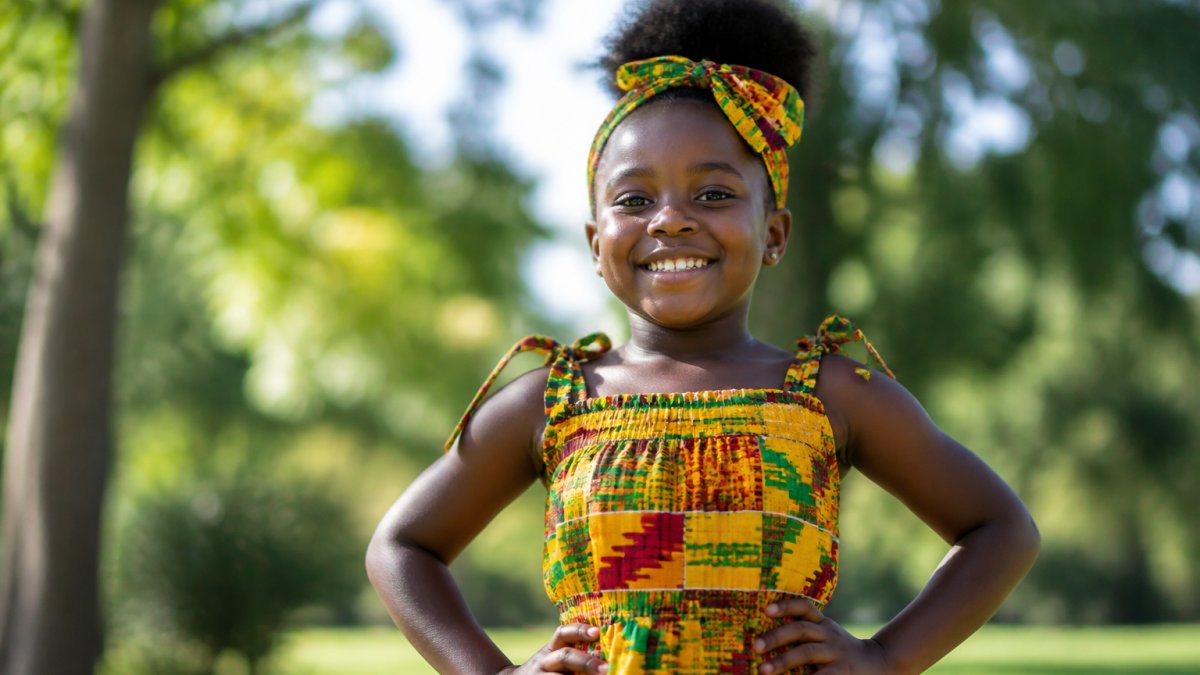
Psychologists call this the "mirror effect": girls who see themselves in positive role models develop stronger self-image and higher aspirations.
Practical ways to increase representation:
- Read books featuring girls who look like your daughter as the hero, not a side character
- Watch movies and shows with diverse leads and positive Black girl characters
- Follow social media accounts of women in fields your daughter is interested in
VivaSistah's culturally affirming apparel, like the Super Sistah Organic Cotton Kids T-Shirt ($29.99), does this work through clothing.

Similarly, the Afrika "I Love My Natural Hair" Organic Cotton Kids T-Shirt ($29.99) celebrates natural beauty and self-expression, helping girls internalize pride in their appearance and identity.

Step 6: Address Social Media, Body Image, and Peer Pressure
Social media and peer pressure directly impact how girls view themselves. Today's girls constantly compare themselves to filtered images and curated versions of their peers' lives.
Body image pressure starts younger than ever: girls as young as 8 report appearance dissatisfaction, and social media makes comparison constant.
How to address this with your daughter:
- Talk openly about filters and editing. Explain that what she sees online isn't real.
- Limit social media time. Research suggests more than 2 hours daily correlates with increased anxiety and low self-esteem.
- Follow accounts that feature diverse body types, ages, and abilities.
Peer pressure intensifies in middle and high school, with pressure to be thin, dress a certain way, date, use drugs, or conform to narrow femininity.
When peer pressure arises:
- Validate her feelings. "That sounds really hard" matters more than "just ignore them."
- Role-play difficult conversations. Practice what she might say.
- Help her identify her own values. "What matters to you, separate from what your friends think?"
Step 7: Create a Parent-Child Conversation Framework
The conversations you have with your daughter shape her self-esteem more than anything else, but they're often awkward. A framework makes them easier.
Opening difficult conversations about self-doubt
The framework:
- Notice without judgment. "I've noticed you seem worried about trying out for the team. Tell me what's going on."
- Listen fully. Don't interrupt or immediately problem-solve. Let her talk.
- Validate her feelings. "That makes sense. Trying something new is scary."
- Ask curious questions. "What's the worst thing that could happen?" or "What would you need to feel more confident?"
- Share your perspective. "When I was your age, I felt the same way. Here's what I learned..."
- Offer support, not solutions. "How can I help?" instead of "You should just do it."
Example conversation:
You: "I noticed you didn't go to soccer practice this week. What's happening?"
Her: "I'm not good enough. Everyone else is better.
You: "That sounds really discouraging. When did you start feeling this way?"
Her: "Last week when I missed that goal."
You: "One missed goal made you feel like you don't belong on the team?"
Her: "It's not just that. I'm always the worst one there."
You: "I hear that.
Navigating school, bullying, and peer challenges
School and peer situations hit different because they happen in her social world, not just at home. She might not tell you about bullying because she's embarrassed or worried you'll make it worse.
Create safety first:
- Tell her explicitly: "If someone is being mean to you or making you feel bad, I want to know. I won't be angry at you, and I'll help figure out what to do."
- Listen without immediately jumping to action. Sometimes girls just need to be heard.
- Believe her. Don't minimize or make excuses for the other person.
Then address the situation:
- If it's mild peer conflict, help her practice responses and coping strategies.
- If it's bullying (repeated, intentional harm), involve the school. Document what's happening.
- Help her find her people. One supportive friend or a club where she feels accepted matters enormously.
| Situation | Your Approach | Outcome |
|---|---|---|
| One unkind comment | Listen, validate, help her process | She learns not all comments define her |
| Repeated exclusion | Involve school, build other friendships | She finds her community |
| Cyberbullying | Document, report platform, consider blocking | She learns boundaries online |
| Physical bullying | Involve school immediately and police if needed | She feels protected |
Frequently Asked Questions
What are the most effective self-esteem activities for girls?
Self-esteem activities for girls work best when they combine reflection, challenge, and celebration. Journaling encourages self-awareness; taking on new activities builds resilience and expands her sense of capability; goal-setting with progress tracking shows tangible growth. The key is variety: mix quiet activities like journaling with active pursuits like sports or arts. Activities that highlight her unique strengths, whether that's creativity, kindness, or leadership, reinforce positive self-image. Pairing these with culturally affirming clothing, like pieces featuring strong role models, creates daily reinforcement of her worth and potential.
How can positive affirmations for girls actually change her mindset?
Positive affirmations for girls work by interrupting negative self-talk and rewiring her internal narrative over time. When a girl hears and repeats affirmations aligned with her real strengths and efforts, she begins to internalize them. Age matters: younger girls respond to simple, concrete affirmations ('I am strong,' 'I can try new things'), while older girls benefit from affirmations addressing specific challenges ('I can handle mistakes and learn from them'). Consistency is critical, daily practice, especially during vulnerable moments, creates lasting change. Affirmations paired with visible reminders, like wearing clothing with empowering messages, reinforce the message throughout her day.
What are signs of low self-esteem in girls that parents should watch for?
Signs of low self-esteem in girls include avoiding challenges or new activities due to fear of failure, excessive self-criticism, seeking constant reassurance, withdrawing from peers, or expressing negative self-talk like 'I'm not good enough' or 'I'm stupid.' Physical signs may include poor posture, avoiding eye contact, or reluctance to participate in class. Some girls mask low self-esteem through perfectionism or people-pleasing. Changes in eating habits, sleep, or mood can signal deeper struggles. If low self-esteem persists despite encouragement, interferes with school or friendships, or shows signs of anxiety or depression, professional support from a counselor or therapist is appropriate.
How does clothing and representation help build girls self-esteem?
Clothing that celebrates a girl's identity, heritage, and strength sends a powerful daily message: 'You belong, you matter, you are enough.' When girls wear apparel featuring strong role models, culturally affirming designs, or empowering messages, it becomes a visible affirmation of her worth. This representation matters especially for Black girls, who often see limited positive reflections in mainstream media. Quality, comfortable clothing also signals that her body deserves care and respect. Brands like VivaSistah offer superhero-inspired, culturally affirming pieces, such as the Super Sistah Organic Cotton Kids T-Shirt ($29.99) or the Afrika 'I Love My Natural Hair' tee ($29.99), that combine comfort with messaging that reinforces confidence and self-love daily.
Building girls self-esteem isn't a one-time project. It's an ongoing practice of noticing her efforts, reflecting her strengths back to her, and helping her navigate the world with confidence. At VivaSistah, we know that what girls wear matters too. When she puts on clothing that celebrates her identity and reminds her she's powerful, that daily reinforcement builds confidence from the outside in. Start with one step from this guide, then add another. Consistency beats perfection every time.