

Last Updated: November 8, 2026
Quick Summary
To measure a child for a long sleeve shirt, run a soft measuring tape from the bony shoulder point down the outside of the arm to the wrist bone, keeping the arm relaxed and straight. Measure both arms and record the longer number, then add about half an inch for growth room.
- You need a soft measuring tape, a fitted shirt, and a second pair of hands.
- Stop at the wrist bone, not the knuckles, for a clean sleeve finish.
- Measure chest, waist, and body length too, since sleeve length alone will not pick a size.
- If measurements differ by more than half an inch, measure a third time.
- Add a full inch to the sleeve for a shirt worn next fall.
Table of Contents
- Before You Start: What You'll Need to Measure a Child
- How to Measure Sleeve Length on a Child, Step by Step
- Taking the Rest of the Body Measurements: Chest, Waist, and Body Length
- How to Measure a Shirt That Fits: A Shortcut for Busy Parents
- Reading a Kids Shirt Size Chart by Measurements
- Using a Kids Clothing Size Chart by Age as a Starting Point
- Getting an Accurate Fit: Common Mistakes and Tips for Wiggly Kids
- Measuring for Different Long Sleeve Styles and Growth Room
- Frequently Asked Questions
Before You Start: What You'll Need to Measure a Child
You can learn how to measure a child for a long sleeve shirt in about five minutes with two simple tools. No special kit is required, and you do not need a tailor. Many parents order a size up "just in case" and end up with sleeves that swallow small hands. A quick measurement helps avoid that.
Here is what you need before you begin:
- A soft measuring tape. The flexible cloth or vinyl kind used for sewing. A stiff metal tape measure will not follow the curve of a shoulder.
- A second pair of hands. One adult holds the tape; the other keeps the child steady. Grandmothers, aunts, and older siblings all work well here.
- A thin, fitted shirt. The child should wear something close to the body, not a bulky sweatshirt.
One more thing: measure over a fitted shirt, never over a coat. A common mistake is measuring a child in whatever they happen to be wearing. That adds bulk and gives you a sleeve that hangs past the wrist.
Soft Measuring Tape and a Willing Helper
A soft measuring tape works best for this job. Look for one marked in inches on one side and centimeters on the other.
Keep the tape snug but never tight. You should be able to slide one finger under it.
Your helper has one job: keep the child facing forward with arms relaxed. That is harder than it sounds with a five-year-old.
How to Measure Sleeve Length on a Child, Step by Step
The fastest way to measure sleeve length on a child is a three-point path: shoulder point, down the arm, to the wrist bone. Follow that line and you get a number that matches how shirts are actually cut.
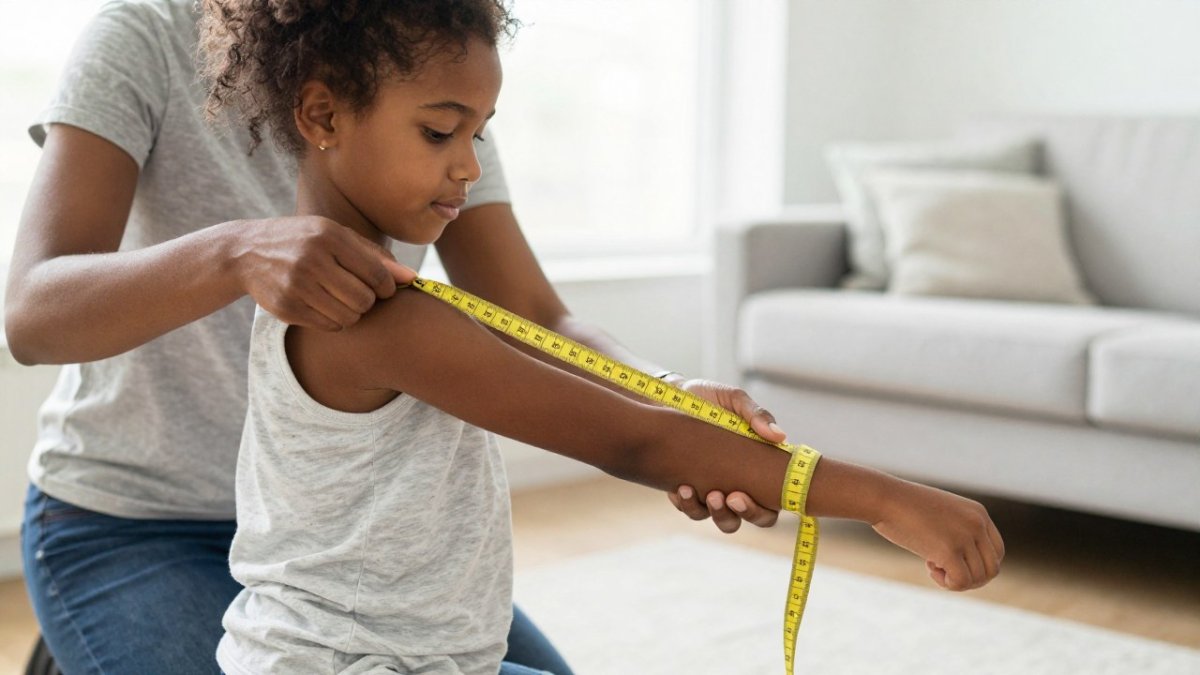
Here are the steps in order:
- Have the child stand tall with arms relaxed at the sides.
- Find the shoulder point on the arm you are measuring.
- Place the tape's zero end at that point.
- Run the tape down the outside of the arm, past the elbow.
- Stop at the wrist bone, right where the hand begins.
- Read the number and write it down.
- Repeat on the other arm. Children are not perfectly symmetrical, and neither are handmade garments.
This measurement varies with age and build. Record the longer of the two arms if they differ.
Finding the Shoulder Point and the Back of the Neck
The shoulder point is the bony tip where your child's shoulder meets the arm. Press gently and you will feel it. It sits at the outer edge, not on top of the shoulder and not halfway down the arm.
Some size charts measure sleeve length from the back of the neck instead. This is common in uniform and pattern drafting.
Measuring Down to the Wrist
Stop at the wrist bone, not the knuckles. A sleeve that reaches the knuckles will bunch up every time your child writes or eats.
Keep the arm straight but relaxed. For a fuller guide to the rest of the process, our step-by-step walkthrough on how to measure kids for clothes covers the full body in the same order.
Follow this three-point path from shoulder to wrist bone and you get a number that matches how shirts are actually cut.
| Step | What to do |
|---|---|
| 1 | Child stands tall, arms relaxed at sides |
| 2 | Find the shoulder point on the arm |
| 3 | Place tape's zero end at that point |
| 4 | Run tape down outside of arm, past elbow |
| 5 | Stop at the wrist bone, where hand begins |
| 6 | Read the number and write it down |
| 7 | Repeat on the other arm |
Taking the Rest of the Body Measurements: Chest, Waist, and Body Length
Sleeve length alone will not pick a size. You also need chest, waist, and body length, because a shirt that fits the arms can still pull across the chest or ride up at the hem.
- Chest: Wrap the tape around the fullest part of the chest, directly under the arms. Keep the tape level all the way around, check that the front and back sit at the same height. Have your child breathe normally and read the number at the end of a normal exhale, not a deep breath. Chest measurements vary widely with age and build.
- Waist: Find the natural waistline, the narrowest point above the hips. On younger children this is often just above the belly button; on older kids it sits a little higher. Do not measure over a waistband or a tucked-in shirt. Keep the tape snug but not tight, you should still be able to slide one finger under it.
- Body length: Start at the base of the neck at the center back and measure straight down to where you want the hem to sit. For a tee, that is usually just below the hip; for a tunic or a shirt meant to be tucked, measure to mid-hip. Keep the tape vertical and let it follow the curve of the back rather than pulling it straight down away from the body.
Watch out: measuring the chest over a bulky sweatshirt or a thick sweater adds an inch or more and gives you a shirt that gapes at the underarm.
Write all four numbers next to the sleeve length. Now you have a full picture of your child's body, not just one arm. When you compare these numbers to a size chart, use the largest measurement to choose the size, if the chest says medium and the sleeve says large, order the large and accept a slightly longer sleeve.
How to Measure a Shirt That Fits: A Shortcut for Busy Parents
If you already own a long sleeve shirt that fits your child well, you can skip the child entirely. This is the shortcut we recommend when a kid will not stand still, and it works surprisingly well.
Here is how to measure a shirt that fits:
- Lay the shirt flat on a table and smooth out the wrinkles.
- Measure from the center of the collar to the end of the cuff for sleeve length.
- Measure straight across the chest, just below the armholes, and double that number.
- Measure from the collar seam down to the hem for body length.
The catch is that a washed shirt may have shrunk. Cotton tees often lose a little length after the first few washes. Allow for some shrinkage if the shirt is old.
Reading a Kids Shirt Size Chart by Measurements
A kids shirt size chart by measurements matches your numbers to a letter or number size. Read the chart by your child's largest measurement, not the smallest.
Most youth charts list height, chest, and sleeve length in inches.
Watch out: charts from different brands do not always agree. When you shop online, our guide to buying kids clothes online walks through the checks that save you a return.
Using a Kids Clothing Size Chart by Age as a Starting Point
Age is a rough guide, never a rule. A kids clothing size chart by age gives you a place to start, but two eight-year-olds can wear completely different sizes.
Use age to narrow the list, then confirm with measurements. A tall, slim child often needs a smaller width and a longer sleeve.
If your child lands between sizes, size up. Kids grow, and a little extra sleeve length is easier to live with than a shirt that pinches by spring.
Getting an Accurate Fit: Common Mistakes and Tips for Wiggly Kids
Accuracy comes down to repeatability. Measure twice, and if the two numbers differ by more than half an inch, measure a third time. That gap usually means the tape slipped or the arm moved.
The mistakes we see most often:
- Measuring over bulky clothing instead of a fitted shirt.
- Letting the tape sag instead of keeping it straight along the arm.
- Measuring a bent elbow, which shortens the sleeve.
For a child who will not stay still, try these tricks:
- Measure while they watch a short video or stand at a counter with a snack.
- Measure one arm, take a break, then measure the other.
- Measure a favorite shirt flat on the table as a backup.
Watch out: do not pull the tape tight to keep it in place on a moving child. A tight tape reads short and gives you a sleeve that will not cover the wrist.
Measuring for Different Long Sleeve Styles and Growth Room
Not every long sleeve shirt is cut the same.
- Fitted tees: Use your exact sleeve measurement. These are cut close, so there is little spare room. If your child measures 18 inches from shoulder point to wrist, an 18-inch sleeve will sit at the wrist bone with no bunching.
- Hoodies and sweatshirts: Add an inch or two to the sleeve and chest. Layering underneath eats up length, and a hoodie cut to your exact measurement will feel tight across the shoulders once a tee is underneath.
- Uniform shirts: Follow the school's chart, which often runs roomier in the body. Uniform sleeves are frequently cut to be worn with a cuff buttoned or rolled, so check whether the chart measures to the wrist bone or to the knuckle.
Growth room is a judgment call, and the right amount depends on when your child will wear the shirt.
Cuff placement matters as much as sleeve length.
Watch out: adding growth room to both the sleeve and the chest at the same time can turn a fitted tee into a baggy shirt.
When you are ready to put those numbers to use, our classic crew neck cotton long sleeve tee is a regular-fit youth option made from soft combed and ring-spun cotton, with ribbed cuffs and sizes S through L. The Super Sistah logo youth long sleeve tee is made from the same cotton and uses a regular fit.


Getting the fit right takes five minutes and saves a return. At VivaSistah, we design superhero-inspired apparel for young Black girls with soft Airlume combed and ring-spun cotton, a regular fit, and ribbed cuffs that keep their shape wash after wash. Our culturally affirming designs celebrate her strength and story, and every order ships fast with secure payment. Get started with VivaSistah and find the size that lets her move, play, and own her story in comfort.
Frequently Asked Questions
Should I measure my child's body or a long sleeve shirt that already fits?
Both work, but they answer different questions. Measuring the body tells you her true size, which is what most size charts on kids clothing sites use. Measuring a shirt that fits gives you the garment's length and width, which you compare to a brand's size guide. For a growing child, body measurements are the safer starting point because they stay accurate even when a favorite shirt shrinks or stretches.
How do I measure sleeve length on a child who won't stand still?
Measure in short bursts and keep it playful. Have her stand with arms relaxed at her sides while you hold the tape at her shoulder point, then let her stretch her arm out to finish at the wrist. If she wiggles, measure twice and use the longer number for sleeve length so there is room to move. Measuring a shirt that already fits her is a good backup when she refuses to cooperate.
What should I do if my child's measurements fall between two sizes?
Size up for long sleeve shirts. Kids grow quickly, and a little extra sleeve length and body room means the shirt lasts through a season instead of a few weeks. Check the size chart's length and width numbers rather than the letter alone, and compare them to her body measurements. If she is tall and slim, size up for the sleeves and expect a slightly looser body fit.
How much room should a child have in a long sleeve shirt?
Aim for about 1 to 2 inches of ease in the chest and roughly half an inch to an inch past the wrist bone in the sleeve. That allows her to raise her arms, reach overhead, and move comfortably without the cuffs sliding down over her hands. If the sleeve stops short of her wrist bone when her arms are at her sides, the shirt is too small.
